




 1/5

 3/5

 5/5
Scrim
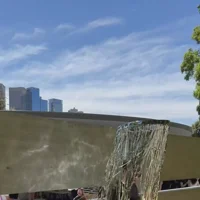
Drawing on the Light and Space precedents of Robert Irwin’s scrim installations - which used sheer, taut fabric to alter the volume and atmosphere of a room - I began carrying a piece of semi-translucent fabric out into the world. My initial instinct was simply to place this material in different environments and watch how the spaces around me projected themselves onto its surface.
Through this physical interface, the material’s semi-opacity brought multiple territories into direct relation. The fabric allowed for muted, blurred sightlines to the world beyond, while simultaneously catching the light and acting as a surface for immediate projection. Over time, I began treating the scrim as an active canvas, painting impressionistically on it to record my experiences of the surrounding environment. Eventually, I hung these painted fabrics inside my home, progressively cutting physical apertures into them. This created a complex, layered textility: a superimposition of painted marks, cast shadows, holes, and the physical world beyond actively interpenetrating the surface.
This practice functioned as an exercise in what philosopher Erin Manning calls thresholding. Manning conceptualises thresholding as an active, emergent, and porous process. Crucially, she notes that for these practices to be generative, they must include explicit constraints that perform and reshape space. By cutting, painting, and layering the fabric, I was spatially testing how a threshold might be articulated not as a hard architectural barrier, but as a yielding, semi-permeable membrane that actively negotiates what is allowed to pass through.
Soft Improvisation
2022
Library

Lawrence Weschler, "Seeing is Forgetting the Name of the Thing One Sees: a life of contemporary artist Robert Irwin"
I was interested in Robert Irwin's use of scrim as a spatial device that shifts the viewer's perception of space, and so I read more on the subject during this project. In Seeing Is Forgetting the Name of the Thing One Sees, Irwin describes scrim as a "defocusing element" that sets up a profound spatial ambiguity. He notes that the material skews expectations and tilts the perceptual mechanism, allowing you to perceive a room as you otherwise might not have.
I took this idea—that a gauzy, semi-transparent screen creates a certain ambiguity between where the body ends and the world begins - and worked with it throughout this soft improvisation. Irwin's reflections offered a framework for understanding how such a material allows the world to interpenetrate itself. This text provided the conceptual foundation for treating my own semi-opaque fabrics as active, yielding membranes that continuously negotiate the physical and perceptual boundaries of a space.